International Domain Name Mistakes: What's Real, What's Myth, and What Actually Costs You
Reviewed by the Domain Search King editorial team · Updated July 2026
The Chevy Nova "didn't sell in Latin America" story is the most-repeated example in naming articles — and it's false. But real cross-language naming disasters did happen, IDN homograph phishing is a live threat against any brand crossing scripts, ccTLD residency rules can make a domain you want simply unregisterable, and WIPO handled a record 6,282 domain disputes in 2025. Here's what's verified, what's urban legend, and how to actually vet a name before you register it internationally.
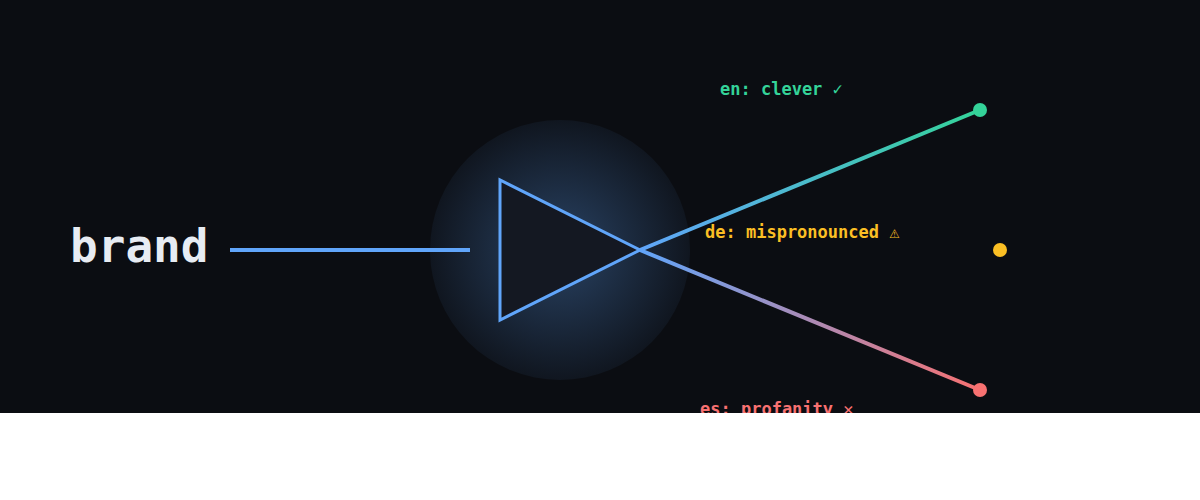
The Myth That Refuses to Die: Chevy Nova
Almost every article about international naming disasters opens with the same story: Chevrolet supposedly launched the Nova in Latin America, sales flopped because "no va" means "doesn't go" in Spanish, and the humiliated company had to rename it. It's a great story. It's also not true.
Snopes traced the claim and found it doesn't hold up linguistically or commercially: "no va" is two words with stress on the second syllable, while "Nova" is one word stressed on the first — Spanish speakers don't hear them as the same thing, and nobody describing a broken car reaches for "no va" anyway; they'd say "no marcha" or "no funciona." More importantly, the sales data contradicts the myth outright — the Nova sold well in both Mexico and Venezuela, with Venezuelan sales actually beating GM's own expectations, and the model name was never changed for Spanish-speaking markets (Snopes).
Why does this matter for an article about naming mistakes? Because the whole case for careful international vetting gets weaker every time it leans on a debunked anecdote instead of a real one. Fortunately, there's no shortage of real ones.
Real Cross-Language Naming Failures (Verified)
Unlike the Nova, these cases are documented, sourced, and in most instances resulted in an actual rename before or shortly after launch.
| Brand / product | Original name | The problem | What happened |
|---|---|---|---|
| Mitsubishi Pajero | Pajero (named for a wildcat) | "Pajero" is Spanish slang for a vulgar term for a masturbator | Sold as Montero in Spain and the Americas, Shogun in the UK (Wikipedia) |
| Mazda Laputa | Laputa (Gulliver's Travels' floating island) | Reads as "la puta" — Spanish for "the whore" | Never launched in Spain; renamed in other Spanish-speaking markets (Bigwheels.my) |
| Honda Fit | Fitta (planned name) | A vulgar term for female genitalia in Swedish, with similar issues in Spain and Italy | Renamed Jazz (Europe/Asia/Australia) and Fit (US/China) before launch (Carscoops) |
| Vicks | Vicks VapoRub | German "V" is pronounced like an English "F," and "Vicks" collides with a vulgar conjugation of "wichsen" | Sold as "Wick" in German-speaking markets (except Switzerland) (Wikipedia) |
| SEGA | SEGA (unchanged) | "Sega" is Italian slang for masturbation, alongside its literal meaning of "saw" | Name kept, but became a persistent source of jokes and marketing awkwardness in Italy (Genesis Temple) |
| IKEA workbench & desk | Fartfull, Jerker | Swedish-derived product names read as crude or juvenile in English | Names retained in Sweden's naming system; became internet-famous punchlines abroad (Mental Floss) |
Notice the pattern: most of these weren't caught by a spellcheck or a dictionary lookup — they needed someone who actually speaks the target language to say the name out loud and flag the collision before launch, not after.
IDN Homograph Attacks: When Someone Else's Domain Looks Exactly Like Yours
International domain risk isn't only about translation — it's also about the underlying character set. Internationalized Domain Names (IDNs) let domains use non-ASCII scripts (Cyrillic, Greek, Chinese, Arabic, and more), which browsers represent internally as ASCII "punycode" strings prefixed with xn--. That system is exactly what makes homograph phishing possible: an attacker registers a punycode domain built entirely from a foreign script's lookalike characters, and the browser renders it as if it were your brand's Latin-script domain.
Security researcher Xudong Zheng demonstrated this concretely in 2017 by registering xn--80ak6aa92e.com — which Chrome, Firefox, and Opera all rendered as "аррӏе.com," visually indistinguishable from apple.com, because every character came from Cyrillic and passed each browser's single-script check (Xudong Zheng). Chrome patched its detection soon after. Firefox's response is worth knowing if you're deciding which browser your users trust by default: Mozilla's own documentation states plainly that "we want to make sure we don't treat non-Latin scripts as second-class citizens," and places the responsibility for catching whole-script lookalikes on domain registries rather than the browser (Mozilla Wiki). Chrome and Firefox now both apply script-mixing checks based on Unicode Technical Standard 39 — Chrome uses the stricter "Highly Restrictive" profile, Firefox the "Moderately Restrictive" one — but neither approach eliminates the risk, it just narrows it (Chromium docs).
ccTLD Registration Restrictions: You Might Not Even Be Eligible
Country-code domains often look like the obvious choice for entering a market — but several of the most desirable ones have real eligibility gates that a generic-TLD registrant never has to think about, and registries actively enforce them after the fact, not just at signup.
| ccTLD | Who can actually register | Enforcement |
|---|---|---|
| .eu | EU/EEA (incl. Iceland, Liechtenstein, Norway) citizens regardless of residence; non-citizens resident in the EU/EEA; entities established there. No non-EU registrant address accepted. | EURid (source) |
| .ca | Canadian citizens, permanent residents, or one of 18 CIRA-defined Canadian Presence Requirement categories. | CIRA runs Registrant Information Validation audits; non-compliant domains are deleted roughly two months after audit notice (CIRA) |
| .fr | Individuals resident in an EU member state; companies established in the EU, Switzerland, Norway, Iceland, or Liechtenstein. | AFNIC verifies legal existence/residential address post-registration; failure can mean suspension or deletion (AFNIC/EuroDNS) |
| .de | No registrant residency requirement, but the "admin-c" (administrative contact) must be a natural person domiciled in Germany, able to receive legal service. | DENIC (IONOS) |
| .cn | Real-name identity verification required for every registrant, including foreigners; foreign registrants provide a passport, and special characters in the registrant name block processing. | CNNIC-mandated review, typically 3-5 business days (GoDaddy) |
| .au | Requires an "Australian presence" — citizenship/residency, or an active ABN/ACN with the domain closely matching the registered business name or activity. | auDA cancels domains if the linked ABN/ACN lapses; the 2022 direct-registration priority window (ended 20 Sept 2022) is now closed to new claims (auDA, VentraIP) |
The practical mistake isn't picking a ccTLD — it's picking one, building a brand around it, and only then discovering you don't qualify, or that you qualify today but could be delisted later if a status (like an ABN) lapses. If you don't clearly meet a ccTLD's eligibility rules, a generic alternative like .co avoids the eligibility question entirely while still reading as international-friendly.
Cross-Border Trademark Exposure: A Record Year for Disputes
Naming across borders doesn't just risk offending someone — it risks infringing someone. WIPO's Arbitration and Mediation Center administered 6,168 UDRP-and-national-variant domain cases in 2024, filed by trademark owners from 133 countries, already the second-busiest year in the service's history (WIPO). 2025 broke that record: 6,282 cases, up 1.8%, the busiest year in the 25-year history of the service and part of more than 80,000 cases resolved since 1999 (Domain Name Wire).
The cross-border dimension is what makes this different from a routine domestic clash: a name that's completely clear in your home country's trademark register can still be a live, registered mark somewhere in your expansion market, and you'd have no way of knowing without checking there specifically. The Madrid Protocol lets you file one international trademark application covering 120+ member countries, but it doesn't cover domain names directly, and it isn't free — extending protection to even three Madrid-member countries runs around $1,605 in system and country fees alone, while direct national filings without the Protocol typically run $1,500-$2,500 per country through local counsel (Gerben Law). That's the real cost of skipping a clearance search before registering a domain and building a brand around it in a new market — and it's a distinct problem from the domestic AI-model-naming disputes covered in our trademark risk breakdown, where the fight is usually within one jurisdiction rather than across several at once.
The Practical Vetting Checklist
None of the failures above required exotic diligence to catch. They required people, not tools — specifically, people who live in the market and speak the language, doing a handful of concrete checks before launch.
What real vetting looks like
- Multiple native speakers who currently live in the target country — not one bilingual coworker
- The name said out loud, tested for pronunciation collisions (the Vicks/Wick case was phonetic, not a translation issue)
- A slang and dialect sweep per country, not per language (Spanish in Spain vs. Mexico vs. Argentina can diverge)
- A check for whether the domain is realistically typeable on the target market's native keyboard layout
- A check for IDN homograph variants of your own brand that someone else could register
- Confirmation you actually meet the ccTLD's eligibility rules before you commit to it
- A trademark knockout search in each expansion market, not just your home country
What doesn't count as vetting
- Running the name through a translation tool and calling it done
- Asking one employee "does this sound weird to you?"
- Assuming a language is a single dialect worldwide
- Assuming your ASCII .com covers you once you operate in non-Latin-script markets
- Assuming a debunked story (like Chevy Nova) means the risk itself is overblown
- Skipping a target-market trademark search because your home-country mark is clear
If you're earlier in the process and haven't settled on a name yet, our domain-naming guide covers the broader selection process this checklist assumes you've already been through. Coined brands often travel better than exact-match keywords — invented vs keyword — and you can generate live-available options as a Namelix alternative. See features.
Check Availability Before You Fall in Love With a Name
Once a name clears native-speaker and trademark vetting, confirm it's actually available — live, not guessed.
Search domains now → What to do if it's takenFrequently Asked Questions
Is the Chevy Nova "didn't sell in Latin America" story true?
No. Snopes and multiple language analyses confirm it's an urban legend: "no va" and "Nova" have different stress patterns and aren't confused by Spanish speakers, and the Nova sold well in Mexico and Venezuela without ever being renamed. It remains the most-repeated fake example in naming articles.
What real cross-language domain and product naming failures have happened?
Several verified cases exist: Mitsubishi renamed the Pajero to Montero in Spanish-speaking markets because "pajero" is Spanish slang for a vulgar term; Mazda's Laputa never launched in Spain because the name reads as "la puta"; Honda almost launched the Fit as "Fitta," a vulgar term in Swedish, and renamed it Jazz/Fit; and Procter & Gamble sells Vicks as "Wick" in Germany because of a pronunciation collision with a vulgar German word.
What is an IDN homograph attack and why does it matter for domain names?
It's a phishing technique that registers a domain built from lookalike Unicode characters (e.g., Cyrillic) that render identically to a trusted brand's domain in a browser's address bar. Researcher Xudong Zheng demonstrated this in 2017 by registering a Cyrillic domain that displayed as "apple.com" in Chrome, Firefox, and Opera. It matters internationally because expanding into non-Latin-script markets multiplies the number of visually confusable variants of your brand that someone else could register first.
Can anyone register a .eu, .ca, .fr, or .cn domain?
No. Each has real eligibility gates: .eu requires EU/EEA citizenship or residency/establishment (no non-EU registrant address is accepted), .ca requires Canadian citizenship, permanent residency, or another CIRA-recognized presence category, .fr requires EU/EEA-area residency or establishment, and .cn requires real-name identity verification with a passport for foreign registrants. Several of these registries actively audit registrants and can delete non-compliant domains.
How many domain name disputes does WIPO handle each year?
WIPO's Arbitration and Mediation Center administered a record 6,282 UDRP domain-name cases in 2025, up 1.8% over 2024's 6,168 cases — the busiest year in the 25-year history of the service, part of more than 80,000 cases resolved since 1999.
What's a practical checklist for vetting a name before going international?
At minimum: get native speakers who live in each target market (not just a bilingual colleague) to check for slang and dialect issues, say the name out loud to test pronunciation across your top languages, confirm the domain is typeable on local keyboard layouts, check for IDN homograph variants of your brand, confirm you actually meet the target ccTLD's eligibility rules, and run a trademark knockout search in your expansion markets before you commit.
Sources
Snopes — Chevy Nova myth debunked · Wikipedia — Mitsubishi Pajero/Montero rename · Bigwheels.my — Mazda Laputa · Carscoops — Honda Fitta/Jazz/Fit · Wikipedia — Vicks/Wick in Germany · Genesis Temple — SEGA in Italy · Mental Floss — IKEA product names · Xudong Zheng — original apple.com IDN homograph research · Mozilla Wiki — Firefox IDN display policy · Chromium docs — Chrome IDN script-mixing policy · Interisle Consulting Group — 2025 malicious gTLD registration data · EURid — .eu eligibility rules · CIRA — .ca Canadian Presence Requirements · AFNIC/EuroDNS — .fr eligibility rules · IONOS — .de admin-c requirement · GoDaddy — .cn real-name verification · auDA — .au direct priority allocation · VentraIP — .au ABN/ACN eligibility · WIPO — 2024 UDRP statistics · Domain Name Wire — 2025 record UDRP statistics · Gerben Law — Madrid Protocol / international trademark cost